Liquid staking protocols let you stake ETH (or another proof-of-stake asset) without locking it away: you deposit ETH, the protocol stakes it with validators, and you receive a liquid token — stETH, rETH, cbETH — that keeps earning staking rewards while you hold it, trade it, or post it as collateral in DeFi. That convenience is why liquid staking became the largest single category in DeFi by total value locked. It is also why the category deserves more scrutiny than it usually gets. The token you hold is not ETH. It is a claim on ETH held by a smart-contract system and a set of node operators, and its market price, its liquidity, and its redemption path all behave differently under stress than they do on a calm Tuesday. This guide explains how the major liquid staking protocols differ, what the on-chain data actually shows about peg stability and liquidity, and how to decide which design — if any — fits the way you plan to use the token.
Quick solution
If you just want the short version: choose a liquid staking protocol by matching the token design to your use case, not by chasing the highest advertised yield. If you plan to hold long-term in a wallet and occasionally sell, a large-liquidity rebasing or reward-bearing token (stETH/wstETH, rETH) is the practical default because exit liquidity is deepest. If you plan to loop the token as DeFi collateral, prioritize peg history and secondary-market depth over headline APR — a token that trades 50 basis points below its fair value at the moment your loan gets margin-called costs you far more than a 0.2% yield difference ever earned. If you cannot tolerate smart-contract risk at all, exchange staking (cbETH, WBETH) trades that risk for custodial risk rather than removing it, and solo staking remains the only option with neither. Verify three things before depositing: the protocol's fee on rewards, the actual redemption mechanism (queue-based withdrawal versus market-only exit), and how concentrated its validator set is. Everything below is the evidence behind those defaults.
Under the hood, every liquid staking protocol performs the same four jobs. It pools deposits from users who individually may hold far less than the 32 ETH a validator requires. It distributes that ETH to node operators who run the validator software. It accounts for rewards and penalties, socializing them across the pool. And it issues a transferable token representing each depositor's share.
The differences that matter live in how each job is implemented:
Token accounting. Rebasing tokens like stETH increase your balance daily as rewards accrue — you hold more tokens over time, each pegged near 1 ETH. Reward-bearing tokens like rETH, cbETH, and wstETH keep your balance fixed while the token's redemption value in ETH rises. Rebasing is intuitive for wallets but breaks composability with some DeFi contracts that assume static balances, which is why Lido offers wstETH, a wrapped non-rebasing version, for use as collateral.
Operator selection. Who actually runs the validators? Lido historically used a curated set of professional operators and has been expanding permissionless participation through its Community Staking Module. Rocket Pool is permissionless: anyone can run a minipool by posting a bond of their own ETH plus RPL collateral, which aligns operator incentives but adds a collateral-management dimension. Exchange products (Coinbase, Binance) run validators in-house — a single corporate operator.
Redemption path. Since Ethereum enabled withdrawals, most major protocols support direct redemption: you burn the liquid token and receive ETH after the exit queue clears, which can take hours to days depending on network conditions. Before relying on it, check whether redemption is native and permissionless or whether your only realistic exit is selling the token on the secondary market — because in a stress event, the secondary market is exactly where the discount appears.
The most important chart for any liquid staking token is not its APR history. It is the secondary-market price of the token against its fair value, because that is the price you get when you need out before the withdrawal queue clears.
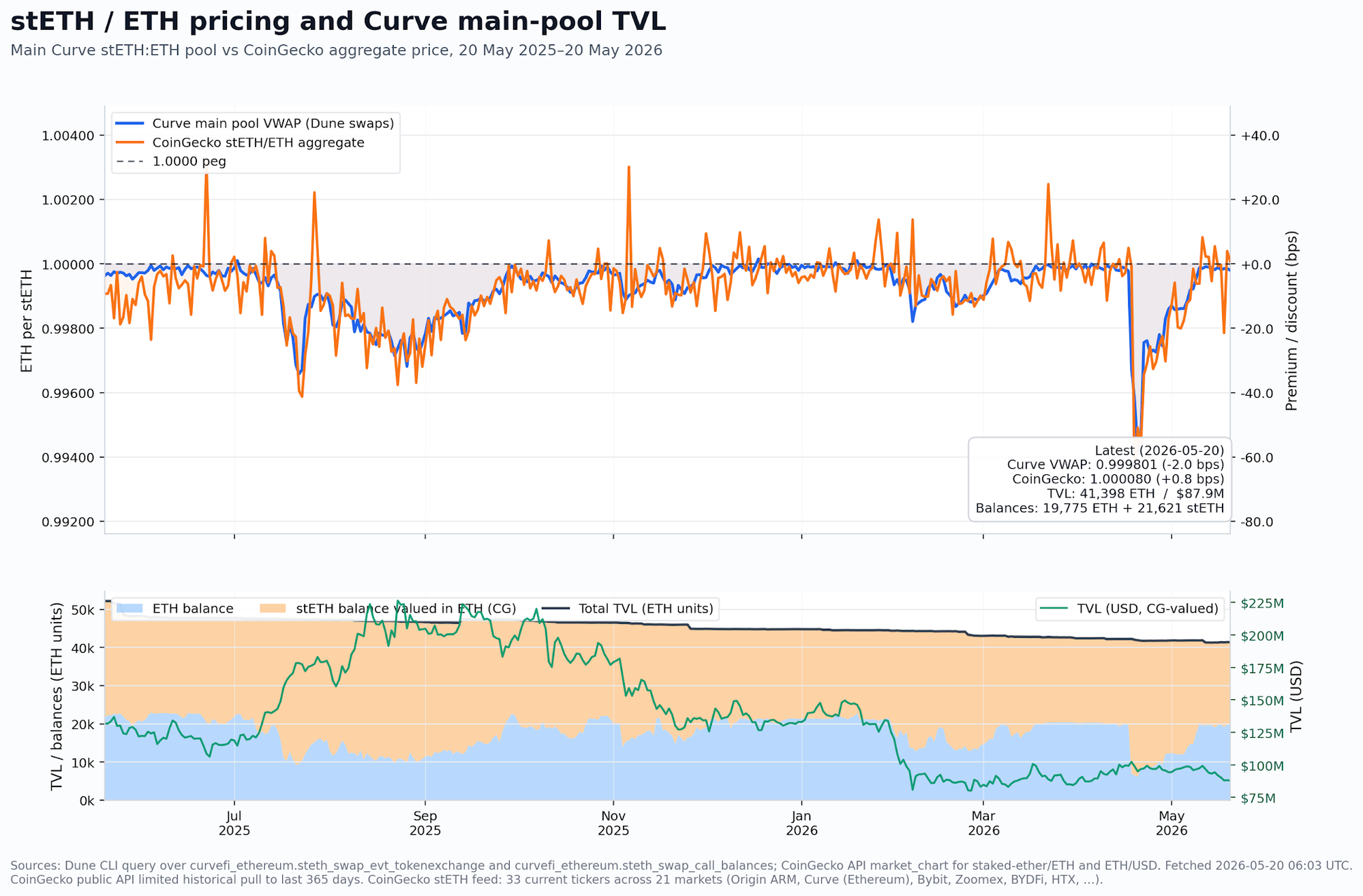
Image: Lido — one year of stETH/ETH pricing (Curve main-pool VWAP versus CoinGecko aggregate) and Curve pool TVL, May 2025 to May 2026.
Two things stand out in this year of data. First, stETH spent almost the entire period within a few basis points of its peg — the Curve pool volume-weighted average price on 20 May 2026 was 0.999801 ETH per stETH, a discount of just 2 basis points. Second, the exceptions matter: the chart shows a drawdown to roughly 40 basis points below peg in mid-2025 and a sharper, briefer dip past 50 basis points in spring 2026. Neither event threatened the underlying stake — the ETH backing the token kept earning rewards throughout — but anyone forced to sell into those windows realized the discount as a real loss. If you borrow against a liquid staking token, those windows are precisely when liquidations cluster.
The same dataset shows the Curve main pool's TVL declining from above $200 million to $87.9 million over the year, with balances of 19,775 ETH and 21,621 stETH at the end of the window. Declining depth in the single largest stETH venue does not mean the token is failing — liquidity has migrated across venues and to withdrawal-based exits — but it does mean you should measure current depth before assuming you can exit size without price impact.
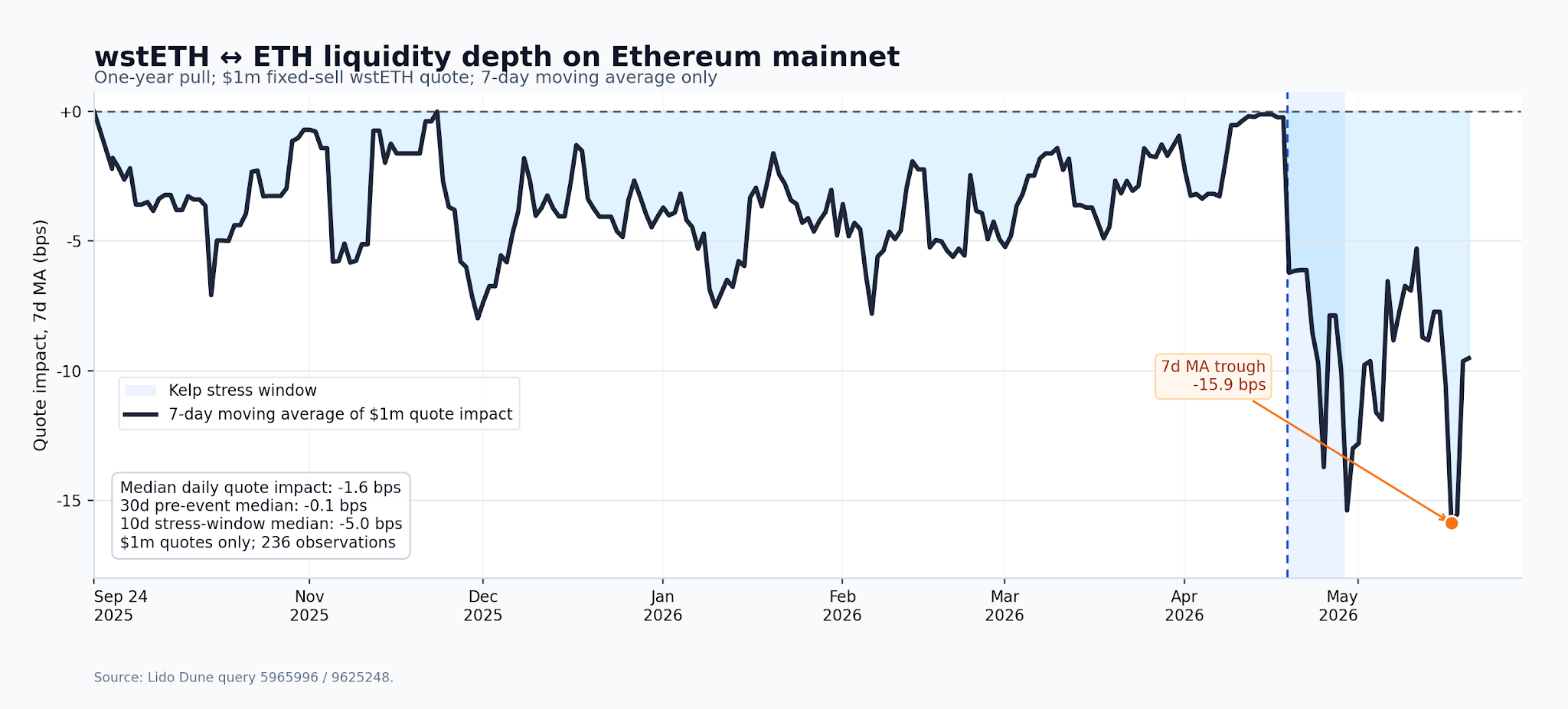
This second chart quantifies exit cost directly: across 236 observations, the median daily price impact of selling $1 million of wstETH was 1.6 basis points — functionally free. During the spring 2026 stress window, the 10-day median widened to 5 basis points and the 7-day moving average bottomed at 15.9 basis points. That is the realistic worst case in recent data for a $1 million exit: about $1,590 of impact on the trade. Larger sizes scale worse, and smaller liquid staking tokens with a fraction of this depth would show materially larger numbers. When you compare protocols, ask for exactly this measurement — quote impact at your intended size, in calm and stressed weeks — rather than accepting "deep liquidity" as a phrase.
Who runs the validators, and why you should care
A liquid staking token is only as sound as the validator set behind it. Slashing — the protocol-level penalty for validator misbehavior — is socialized across the pool in most designs, so operator quality is directly your risk.

Lido's own Q4 2025 reporting is a useful case study because it publishes numbers most competitors do not. As of that report, the Curated Module — 36 professional operators — still held 91.09% of Lido's TVL at just over 8 million ETH, while the permissionless Community Staking Module had grown to 412 operators holding 440,512 ETH (5%) and the Simple DVT module, which splits each validator key across multiple parties using distributed validator technology, held 344,320 ETH across 320 participating operators. The direction of travel is toward more operators and split-key validation; the present reality is still a heavily curated core. Neither fact should be taken on faith for any protocol you evaluate — look for the equivalent disclosure, and treat its absence as information.
Concentration is not only about how many operators there are, but where and how they run.

Geographic spread matters because correlated failures — a regional cloud outage, a national regulatory action, a grid event — hit co-located validators together, and Ethereum's penalty design punishes correlated downtime much harder than isolated downtime. In Lido's Q4 2025 data, Germany alone hosted 67,787 validators, with the United States (44,388), the United Kingdom (26,161), and the Netherlands (24,704) following — real diversification across more than fifty countries, but with meaningful mass in a handful of jurisdictions.

The infrastructure mix tells the same story from another angle: 53.15% of Community Staking Module operators run home nodes, Simple DVT operators favor dedicated servers (60.67%), while nearly half the curated professional set (47.75%) runs on public cloud. Home stakers are individually less reliable but almost perfectly uncorrelated; cloud-hosted professionals are individually excellent but share failure domains. A healthy protocol wants both, and publishes the split so you can check.

Client diversity is the least visible risk and the most catastrophic one. If a supermajority of validators run the same execution client and that client has a consensus bug, correlated slashing could hit every pool built on it. Lido's curated set moved from Geth dominance in 2021 to a 2025 split of 39.1% Nethermind, 37.0% Geth, and 18.7% Besu — no client above 40%. Ask any protocol you evaluate for this chart. If they cannot produce it, they either do not measure it or do not like the answer.
More in Staking & Yield
Comparing the major liquid staking designs
Because no single public source compares liquid staking protocols on token mechanics, fees, operator model, and exit path in one place, we compiled one from each protocol's public documentation and the on-chain data discussed above (verified September 2026).
| Protocol / product | Token and accounting | Fee on staking rewards | Who runs validators | Exit path |
|---|---|---|---|---|
| Lido | stETH (rebasing); wstETH wrapper for DeFi | 10% | Curated professional set plus permissionless Community Staking and Simple DVT modules | Native withdrawal queue or deep secondary markets |
| Rocket Pool | rETH (reward-bearing) | Operator commission per minipool (protocol-set band) | Permissionless node operators posting ETH plus RPL bond | Native redemption against protocol liquidity or secondary market |
| StakeWise | osETH (reward-bearing, minted against vaults) | Set per vault by the vault operator | Permissionless vault operators; you choose the vault | Burn osETH against your vault stake or sell on market |
| Coinbase | cbETH (reward-bearing) | 25% | Coinbase (single custodial operator) | Unwrap via Coinbase account or secondary market |
| Binance | WBETH (reward-bearing) | 10% | Binance (single custodial operator) | Redeem via Binance or secondary market |
| Solo staking (baseline) | None — you hold validator keys | 0% | You | Voluntary exit through the protocol queue |
Three patterns are worth drawing out of the table. First, fees cluster at 10% of rewards for decentralized-ish protocols, while custodial exchange products charge up to 25% — at a 3% base staking rate, that is the difference between netting about 2.7% and about 2.25% annually, before any DeFi use. Second, "who runs validators" is the real decentralization question: two of the six rows are a single company, and the operational transparency documented in the previous section is largely unavailable for them. Third, every option except solo staking has two exits — native redemption and the secondary market — and the secondary-market exit is the one that gets expensive exactly when everyone wants it, as the spring 2026 liquidity data above shows.
The reason to hold a liquid staking token instead of plain staked ETH is composability: the token can work twice. The most common patterns, in rising order of risk:
Passive hold. Deposit, hold stETH or rETH in a wallet, earn the staking rate minus fees. Your added risks over solo staking are the protocol's smart contracts and its operator set. For most holders this is the sane default.
Collateralized borrowing. Post wstETH or rETH as collateral on a lending market and borrow stablecoins or ETH against it. This is the bridge into everything covered in our guide to how borrowing against crypto works — with the specific twist that your collateral's liquidation price now depends on the liquid staking token's market price, peg discount included, not on ETH alone.
Leverage looping. Borrow ETH against your liquid staking token, stake the borrowed ETH, post the new tokens, repeat. This amplifies the staking yield spread and also amplifies exactly the two risks this article quantified: peg discount and exit liquidity. The spring 2026 window in the charts above — a 55 basis point peg dip and a 15.9 basis point $1M exit cost occurring simultaneously — is the scenario looped positions must survive. Before running one, work through the failure modes in our DeFi protocol safety checklist, and stress-test at double the worst historical discount.
Liquidity provision. Supply the token to an AMM pool such as the Curve stETH/ETH pool from the first chart. You earn fees and incentives but take on impermanent loss dynamics around peg moves, which behave unlike a standard volatile-pair pool precisely because the pair is supposed to trade near 1:1.
If your goal is yield on dollar-denominated capital rather than growing an ETH position, liquid staking is usually the wrong tool — see our comparison of stablecoin yield options for that problem, and our overview of DeFi lending platforms for where staked-asset collateral is actually accepted.
Common mistakes when choosing a liquid staking protocol
- Choosing on headline APR alone. Advertised rates across major ETH liquid staking protocols differ by tenths of a percent; peg behavior and exit liquidity differ by an order of magnitude. The cheap-looking protocol that costs you 50 basis points on exit erased years of its APR advantage.
- Treating the token as ETH in risk models. Lending positions, DAO treasuries, and personal spreadsheets that mark stETH or rETH at exactly 1:1 fair value are silently short a peg-stress scenario. Mark to the secondary market and set liquidation buffers against the worst historical discount, not the average.
- Ignoring the operator set because the front end looks decentralized. A protocol can have permissionless governance and still concentrate 90% of stake with a few dozen operators, as the module data above shows even for the market leader. Read the operator disclosures; absence of disclosure is a data point.
- Assuming redemption is instant. Native withdrawals clear through Ethereum's exit queue, which is measured in hours normally and can stretch to days when many validators exit at once — which is, again, exactly when you are most likely to want out. If your plan requires same-block exit, your real exit is the secondary market at whatever discount prevails.
"We are a long-term ETH holder with no DeFi positions, and we just want our idle ETH working." Passive liquid staking or solo staking, decided by size and operational appetite. At 32+ ETH with the willingness to run hardware, solo staking pays the full rate with no protocol risk. Below that, or without the appetite, a large-liquidity protocol token held passively adds roughly one smart-contract-plus-operator risk in exchange for the yield — and the operational data published by the protocol (operator count, client diversity, geographic spread) is your due-diligence checklist.
"We are a DeFi-active trader who wants staking yield on collateral we already use." Use the non-rebasing form (wstETH rather than stETH) for contract compatibility, size positions against the worst historical peg discount rather than the current price, and prefer lending markets that use exchange-rate-aware oracles for liquid staking tokens rather than raw spot price, so a transient pool imbalance cannot liquidate you against fair value.
"We are a small fund holding client assets with a mandate to stake conservatively." Your constraint is probably not yield but accountability: you need to explain custody, slashing socialization, and exit mechanics to an LP or auditor. That argues for protocols with published operator metrics and native redemption, a documented maximum-drawdown assumption from peg history (the charts above give you one year of it), and a written answer to "how do we exit 100% of the position in ten days" — using measured quote-impact data at your size, not the phrase "deep liquidity."
Frequently asked questions
Is a liquid staking token as safe as staking ETH directly?
No — it is staking risk plus additional layers: smart-contract risk in the protocol, operator risk in whoever runs the validators, and market risk in the token's peg. The historical data shows those added risks have been small for the largest protocols — a 2 basis point average discount over the past year for stETH — but small is not zero, and the layers exist regardless of brand.
What actually happened when stETH traded below peg?
In the observed events, nothing broke at the protocol level: the ETH backing the token remained staked and earning, and holders who did nothing were unaffected. The discount was a secondary-market price for immediate exit. Sellers during the mid-2025 and spring 2026 windows paid up to roughly 40 to 55 basis points for immediacy; everyone else waited it out or used the withdrawal queue.
Rebasing versus reward-bearing — which token type should I pick?
Functionally they deliver the same economics. Pick reward-bearing (rETH, wstETH, cbETH) if you will use the token in DeFi contracts, since static balances compose cleanly and some jurisdictions treat rebases awkwardly for tax. Rebasing stETH is fine for a wallet hold where watching the balance grow is the point.
Can a liquid staking protocol lose my ETH entirely?
Total loss would require either a catastrophic smart-contract exploit of the staking contracts themselves or slashing across essentially the whole operator set — for example, a consensus bug in a client run by most validators. That is why this article dwells on client diversity and operator concentration: they are the variables that turn "isolated incident" into "correlated loss." Diversified client mixes, split-key DVT validation, and geographically spread operators exist precisely to keep worst cases partial.
Do I owe taxes on staking rewards from liquid staking tokens?
In many jurisdictions, staking rewards are taxable as income when received, and rebasing tokens can make "when received" literal — every day. Reward-bearing tokens typically defer recognition until sale in some regimes, but treatment varies widely and is unsettled in others. This is not tax advice; the honest answer is that token mechanics change your reporting burden, so ask a professional who knows your jurisdiction before choosing between token types for size.
Sources
- Lido, "Validator and Node Operator Metrics — Q4 2025 Report," blog.lido.fi, March 2026.
- Lido, "stETH Liquidity Under Stress: One Year of Pricing and Depth Data," blog.lido.fi, June 2026.
- Ethereum.org, "Staking pools" and validator withdrawal documentation, accessed September 2026.