Borrowing against crypto is the one DeFi activity where the mechanics matter more than the marketing. When you deposit ETH or BTC as collateral and draw a stablecoin loan against it, you are entering a position governed by four numbers — your loan-to-value ratio, the borrow rate, the liquidation threshold, and the health of the protocol's own stablecoin peg — and every one of those numbers moves. Get them right and you unlock liquidity without selling, defer taxable events, and sometimes even earn while you borrow. Get them wrong and an ordinary market dip converts your collateral into someone else's liquidation bonus.
This guide explains how to borrow against crypto through DeFi lending markets, using real published numbers from live protocols rather than idealized examples. We walk through what actually determines your borrow rate, how modern liquidation engines differ from the cliff-edge liquidations of 2021-era DeFi, what happened when a major collateral market went underwater in 2026 and how it recovered, and a sizing framework that survives bad months. Before borrowing anywhere, run the venue through the checklist in our DeFi protocol safety guide — everything below assumes you have already screened the protocol itself.
Quick solution
If you want the safe-default recipe for borrowing against crypto without reading the full mechanics, this is it:
- Borrow stablecoins against blue-chip collateral only — ETH, wrapped BTC, or a major liquid staking token — on a lending market that has operated through at least one full drawdown.
- Cap your initial loan-to-value at 40 percent or less, even if the protocol allows 70-plus. Your buffer is not decoration; it is the entire strategy.
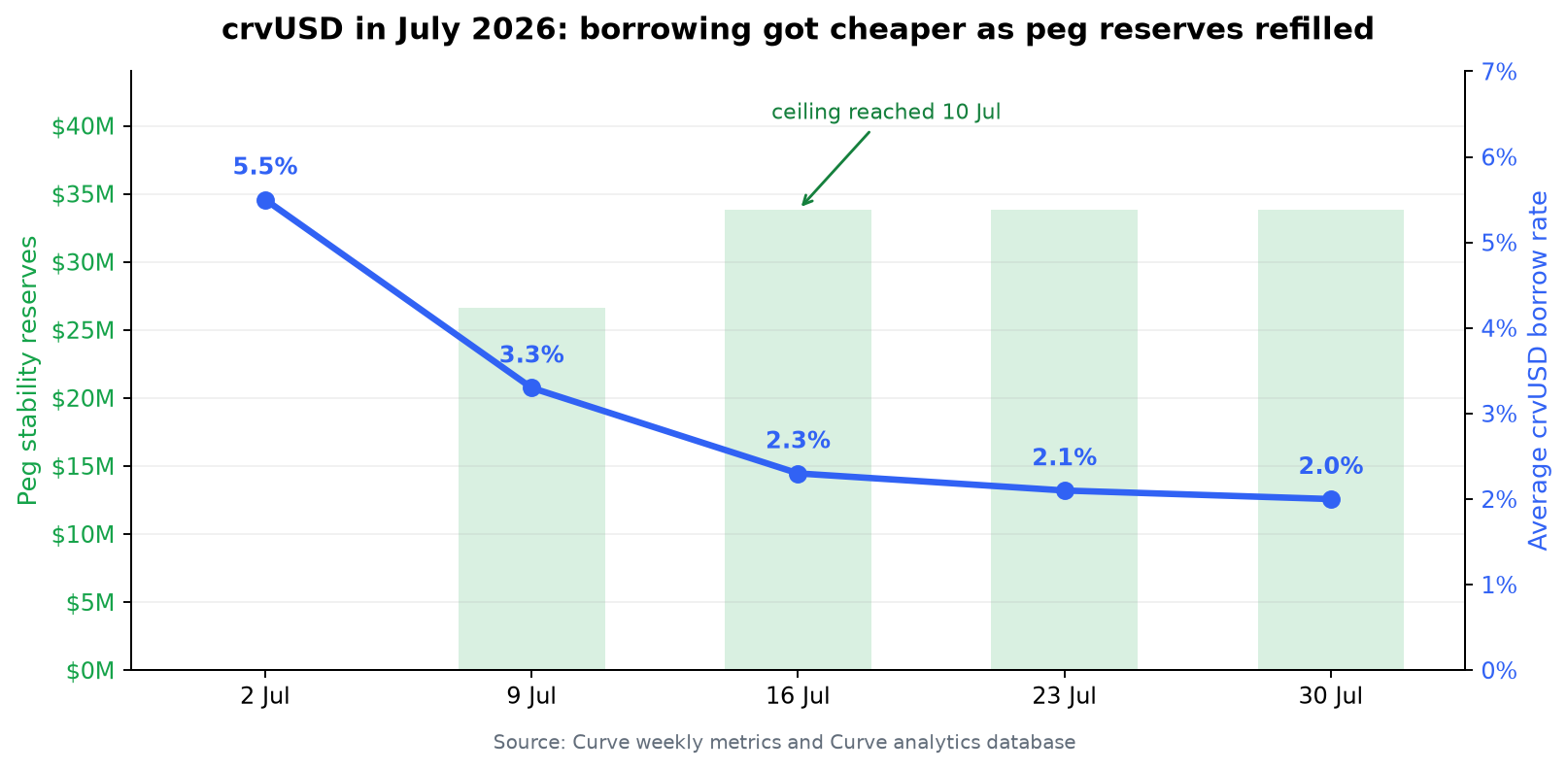
- Check the borrow rate weekly, not once. Published rates on major markets moved from 5.5 percent to 2.0 percent within a single month in mid-2026. Rates are a market, and markets move both ways.
- Know your liquidation mechanism before you sign. Soft-liquidation systems trade your collateral gradually inside a price band; classic systems sell it all at a threshold. The difference decides whether a wick to your liquidation price is an inconvenience or a wipeout.
- Set two alerts: one at the collateral price where your LTV hits 55 percent (time to repay or add collateral), one 15 percent above your liquidation price (act now).
- Never borrow to re-buy the same collateral more than once. Leverage loops compound liquidation risk faster than they compound returns.
The rest of this article is the evidence behind those six rules.
Borrow rates in DeFi are not set by a committee. They are outputs of utilization curves and peg-defense mechanics, which is why they can fall by two-thirds in a month — and why a rate you saw in a screenshot last quarter tells you nothing about what you will pay next week.
Curve's crvUSD system is the clearest published example, because the team reports the mechanics monthly. In July 2026, the average crvUSD borrow rate fell from 5.5 percent to 2.0 percent over four weeks — not because anyone voted to cut rates, but because the peg stability reserves that back the stablecoin refilled, reaching their ceiling on July 10, and the rate controller responded automatically.
The practical lesson generalizes to every DeFi lending venue: your borrow rate is a signal about the system's internal state. On mint-based markets like crvUSD, rising rates mean the stablecoin is trading soft and the protocol is paying borrowers to shrink supply. On pool-based markets, rising rates mean utilization is high and lenders are scarce. Either way, a rate spike is information — the system is under strain — and treating it as merely a cost misses the warning.
Cheaper borrowing also visibly stimulates demand. The same July 2026 report shows crvUSD minting expanding 29 percent in one month, from 28.5 to 36.7 million dollars, while the collateral deposited behind those mints grew 43 percent, from 49.4 to 70.5 million dollars.
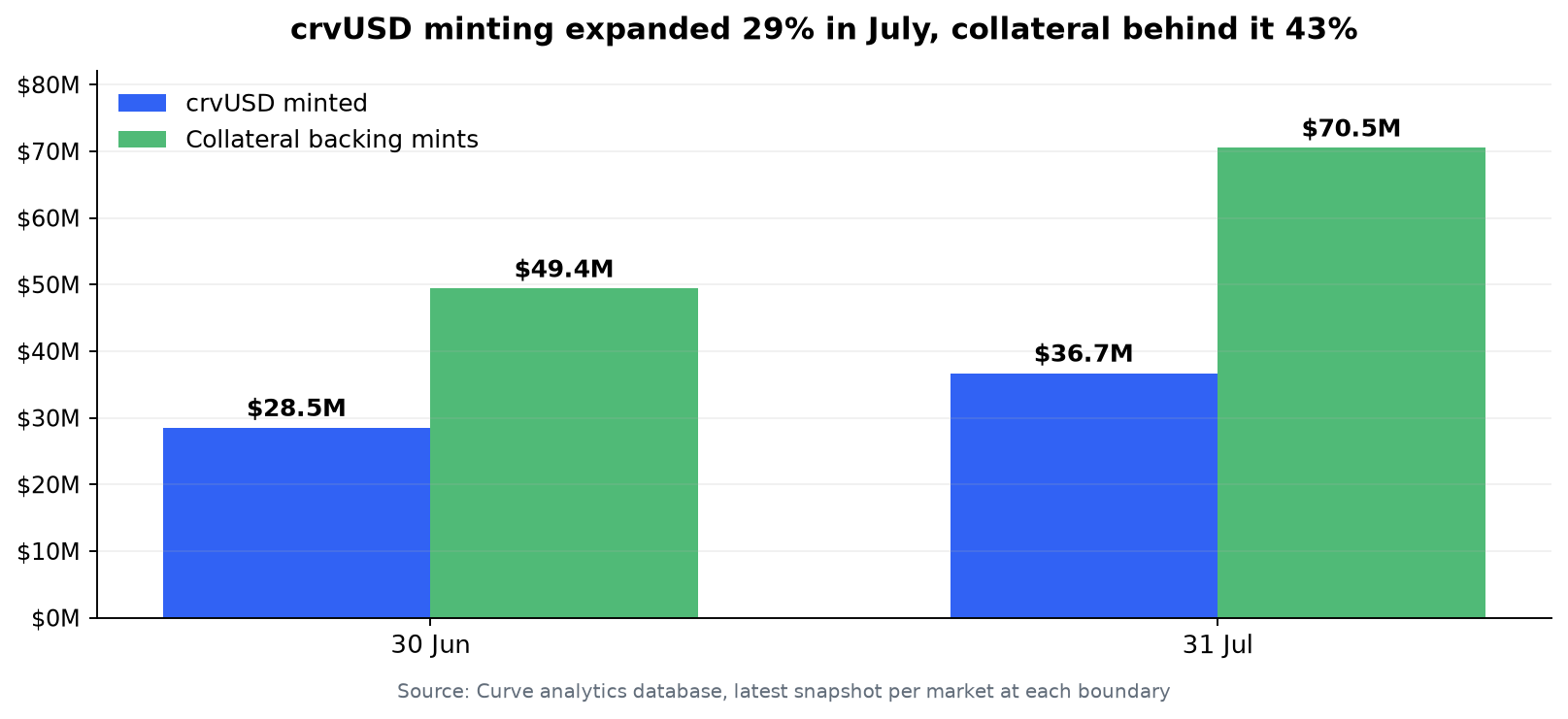
Note the ratio in that chart: collateral grew faster than debt. Borrowers in aggregate ran more conservative loan-to-value as the market expanded — roughly 52 percent LTV on average at end of July. That is the crowd telling you what experienced borrowers consider normal in calm conditions. Your target should be below the crowd, not above it.
Reading a real borrow market screen
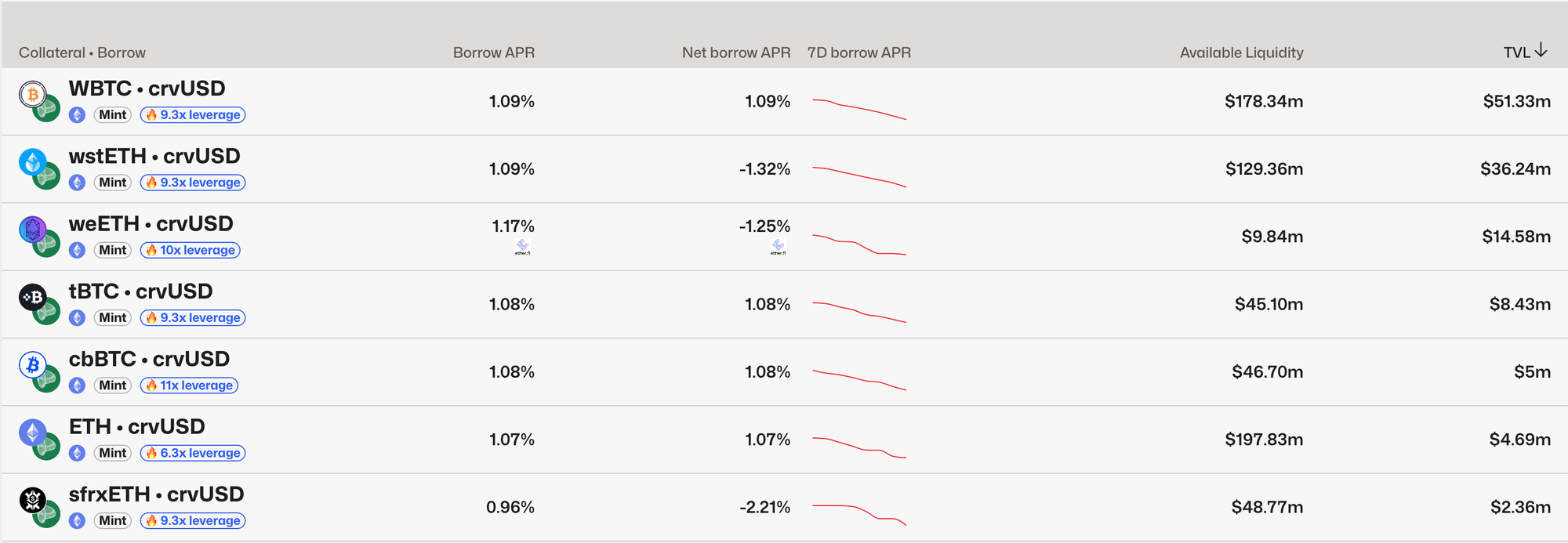
Here is what an actual DeFi borrowing interface shows you, and how to read each column before you commit collateral. This screenshot is Curve's LlamaLend mint-market list from May 2026:
Four readings matter. First, the borrow APR column — around 1.07 to 1.17 percent across markets in that snapshot — is the headline cost, and you now know from the section above that it floats. Second, the net borrow APR is the number that includes what your collateral earns while deposited: wstETH collateral showed negative 1.32 percent, meaning the staking yield on the collateral exceeded the borrow cost, so the position paid its holder to exist. That is the structural advantage of using yield-bearing collateral like the tokens covered in our liquid staking protocols guide. Third, available liquidity caps how much you can actually draw — and more importantly, thin liquidity on the way in means thin liquidity for liquidators on the way out. Fourth, the leverage badges (9.3x, 10x) advertise looping; rule six of the quick solution tells you what to do with that advertisement.
The word "liquidation" covers two very different machines, and knowing which one your venue runs is the single most consequential piece of due diligence in crypto borrowing.
Classic threshold liquidation — the design most lending pools still use — leaves your position untouched until your LTV crosses a line, then sells enough collateral (with a penalty of typically 5 to 13 percent paid to the liquidator) to restore health, all at once, at the worst possible price. A brief wick through your threshold is enough; the position does not heal when the price bounces back.
Soft liquidation — the design pioneered by Curve's LLAMMA and adopted in variants elsewhere — defines a price band instead of a line. As the collateral price falls through the band, the system gradually converts collateral to the borrowed stablecoin; if the price recovers, it converts back. You lose a little to the back-and-forth (traders call it rebalancing loss), but a temporary dip does not destroy the position.
The stress test for the soft-liquidation model came in early 2026, when the CRV token — used as collateral in one LlamaLend market — fell far enough to leave 38 positions underwater. Curve's response shows exactly what an honest post-incident disclosure looks like — a dedicated recovery pool, deployed and tracked in public:
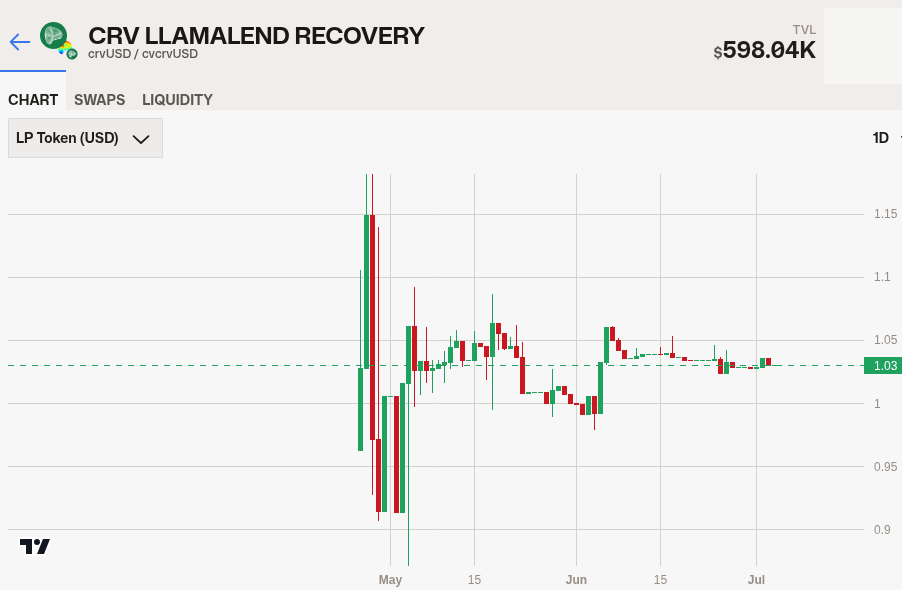
Alongside the pool interface, Curve published a solvency analysis plotting the combined value-to-debt ratio of the affected positions against the collateral price: the pool of bad debt sat near 71 percent solvency at the depressed price, with full recovery beginning if CRV traded back to roughly 96 cents and completing at 1.24 dollars. Two lessons for borrowers. One: even gradual liquidation has limits — a deep, fast crash can outrun the band. Two: a protocol that publishes controller addresses and solvency curves mid-crisis is exactly the kind of counterparty transparency the safety checklist demands; the venues that go quiet during stress are the ones that turn borrower losses into mysteries.
More in Lending & Borrowing
The stablecoin you borrow is itself a risk position
When you borrow a protocol-native stablecoin against crypto, you hold an asset whose peg is maintained by the same system that holds your collateral. If that stablecoin trades at 0.97 when you want to repay, your debt effectively grew 3 percent in real terms at the worst moment. So peg history is part of borrowing due diligence, not a separate topic.
The published record here is checkable. Through the May–June 2026 market drawdown — the same period that produced those underwater CRV positions — crvUSD's daily price stayed inside roughly 0.997 to 1.000:
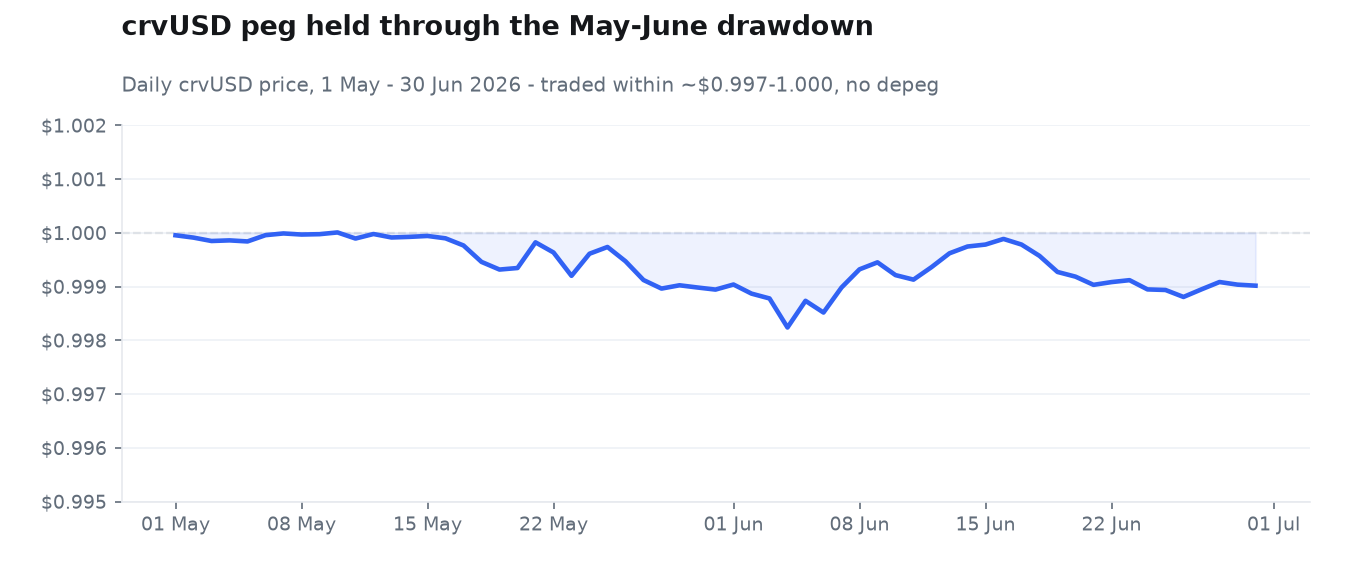
A stablecoin that holds its band through a stress event is demonstrating the property you are relying on. Before borrowing any protocol-native stablecoin, find the equivalent chart for its worst recent month — and if you plan to deploy borrowed stablecoins into yield positions rather than spending them, size that leg against the venue standards in our stablecoin yield guide, because you are now stacking two protocols' risks.
Borrow capacity is also governance-rationed, which surprises first-time borrowers. New markets open with hard caps voted on-chain — in July 2026, Curve's DAO set LlamaLend V2 borrow caps of 12.4 million crvUSD for sDOLA collateral, 28.4 million for sfrxUSD, and 51.8 million for syrupUSDC:
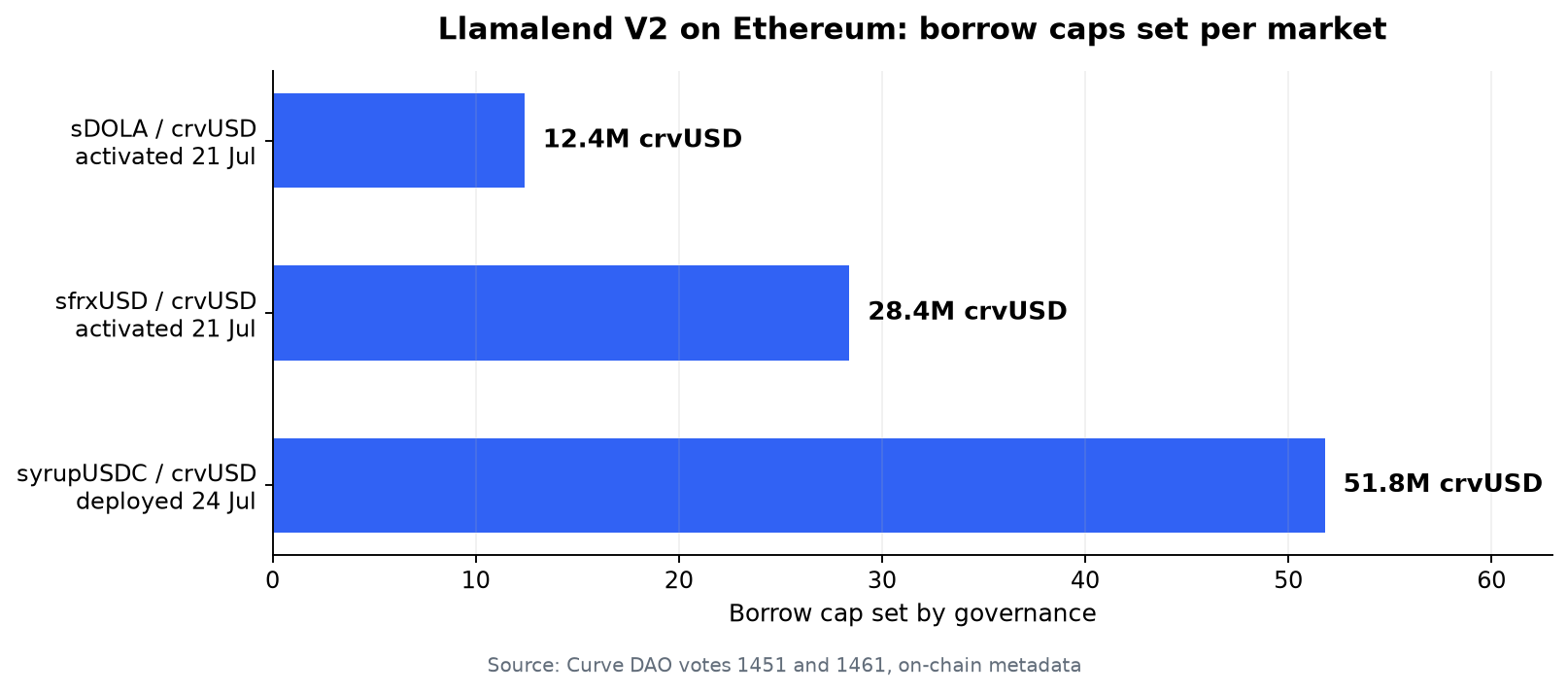
Caps are a safety feature — they limit how much bad debt any single collateral type can generate — but they also mean the liquidity you see today can be fully drawn tomorrow. If your plan involves borrowing more later, a capped market can strand the second tranche.
Choosing a venue: the four ways to borrow against crypto
Because no single public source compares the venue types a crypto holder can actually borrow through, we compiled one from Curve's 2026 monthly reports and recovery disclosures, the published mechanics of the major pooled lending markets, and the documented failure history of centralized crypto lenders.
| Decision factor | Mint market (crvUSD-style) | Pooled lending market | Liquid-staking collateral loop | CeFi lender |
|---|---|---|---|---|
| What sets your rate | Peg-defense controller | Pool utilization curve | Both, plus staking yield | Company pricing desk |
| Rate observed in 2026 examples | 1–5.5 percent, floating | Low single digits, floating | Can be net negative | Mid-to-high single digits |
| Liquidation style | Gradual, band-based | Threshold plus penalty | Threshold, amplified by loop | Margin call, then seizure |
| Bad-month behavior | Published solvency curves | Penalty cascade risk | Depeg and rate risk stack | Withdrawal freezes on record |
| Custody of collateral | Smart contract, self-custody | Smart contract, self-custody | Smart contract, self-custody | The company holds it |
| Transparency during stress | On-chain, reportable | On-chain, reportable | On-chain, reportable | Quarterly statements at best |
| Best suited for | Conservative stablecoin draw | Multi-asset borrowing | Experienced, actively managed | Users who accept counterparty risk for convenience |
The table's sharpest line is the custody row. Every DeFi option leaves collateral in a contract you can verify; the CeFi option hands it to a balance sheet you cannot. The 2022–2023 cycle of centralized-lender failures — frozen withdrawals, then bankruptcy queues — is the base rate you accept for the convenience of a phone-app loan.
Rules of thumb are easier to hold onto when they are anchored to real events, so real situations we hear repeatedly are worth walking through. "We are a startup holding treasury ETH, and we borrowed at 60 percent LTV because the protocol allowed 75" — a routine 20 percent ETH dip put them ten points from liquidation, and the fix (repaying into weakness) is exactly what the 40 percent starting cap in the quick solution exists to avoid. "We are a mining operation borrowing stablecoins against BTC for payroll, and we assumed the 5.5 percent rate we signed at was fixed" — it floated down, in their case, but the point is they had not budgeted for it floating up; always model the rate doubling. "We are a two-person fund running a staked-ETH borrow loop at 3x, and one week of elevated borrow rates flipped our net carry negative" — looped positions convert small rate moves into large equity moves, which is why loops belong in the experienced-and-actively-managed row of the table, not in a set-and-forget treasury.
The framework: start at or below 40 percent LTV; define in advance the price at which you add collateral or repay (the 55 percent LTV alert); hold the borrowed asset or deploy it somewhere you can exit in hours, not days; re-check the borrow rate and your venue's utilization weekly; and treat any governance vote about your market's caps or parameters as a calendar event worth reading.
Common mistakes when borrowing against crypto
- Borrowing at the maximum allowed LTV. Protocol maximums are solvency limits for the protocol, not recommendations for you. The aggregate market borrows near 52 percent; the borrowers who survive drawdowns start near 40.
- Ignoring the difference between borrow APR and net borrow APR. With yield-bearing collateral, the net figure can be negative — and with plain collateral in a rate spike, the real cost can be multiples of the teaser you remember.
- Not knowing the liquidation mechanism. Band-based and threshold-based systems fail differently. If you cannot explain what happens to your position during a 30 percent wick, you have not finished your due diligence.
- Treating the borrowed stablecoin as automatically worth one dollar. Check its published peg history through the worst recent month; your debt is denominated in it.
Frequently asked questions
Is borrowing against crypto better than selling it?
It depends on why you need the liquidity. Borrowing preserves your upside exposure and, in many jurisdictions, defers a taxable disposal — but it adds liquidation risk, floating interest cost, and protocol risk that selling does not carry. The honest framing: borrowing is a leveraged bet that your collateral will outperform your borrow rate plus the risks you took to hold it. For short-term needs at conservative LTV, that bet has historically been reasonable on blue-chip collateral; as a permanent lifestyle strategy at high LTV, it has ended badly in every major drawdown.
What loan-to-value ratio is safe for crypto loans?
No ratio is safe in the absolute sense, but 40 percent or lower against ETH or BTC gives you room to survive the 30-to-40 percent drawdowns that occur regularly in crypto markets, with time to react. The aggregate crvUSD market ran about 52 percent LTV in July 2026; protocol maximums often exceed 70 percent. The gap between what is allowed and what survives is where liquidations live.
Can my borrow rate change after I take the loan?
Yes — on nearly every DeFi venue, continuously. Rates are outputs of utilization or peg-defense controllers, not fixed terms. The documented July 2026 example on crvUSD saw the average rate fall from 5.5 to 2.0 percent in four weeks; the same machinery moves rates upward when the system is under strain. Budget for the rate doubling, and treat a sustained spike as a signal to reassess the whole position.
What happens if my collateral gets liquidated?
On a classic threshold system, a liquidator repays part of your debt and receives your collateral plus a penalty — typically 5 to 13 percent — and the sale is final even if the price recovers minutes later. On a soft-liquidation system, your collateral is converted gradually within a price band and can convert back if the market recovers, at the cost of some rebalancing loss. In both designs, a deep and fast enough crash can still leave the position underwater, which is why position sizing, not the liquidation engine, is your primary defense.
Do I owe taxes when I borrow against crypto?
In most jurisdictions, taking a loan is not a disposal, so borrowing itself does not usually trigger capital gains tax — one of the main reasons long-term holders borrow instead of selling. But liquidations generally are disposals, repaying with appreciated crypto can be, and rules differ materially by country and change over time. Treat this as a question for a qualified tax professional in your jurisdiction, not as settled fact from any article, including this one.
Sources
- Curve, "Curve Monthly Recap — July 2026" — crvUSD borrow rate and peg-reserve mechanics, mint and collateral growth, LlamaLend V2 borrow caps from DAO votes 1451 and 1461 (August 2026).
- Curve, "Curve Monthly Recap — May/June 2026" — crvUSD daily peg history through the drawdown and LlamaLend market screens (July 2026).
- Curve, "Building Recovery in Public" — aggregate solvency analysis of the 38 underwater CRV-collateral positions and the published recovery thresholds (April 2026).