Stablecoin yield sounds simple: park digital dollars, earn interest. But the rate you see advertised tells you almost nothing about where that interest comes from, how it behaves when markets move, or what can take it away. Over the past six years, average stablecoin deposit rates on Aave have swung from over 10 percent during the 2020 "DeFi Summer" to below Treasury bills in late 2022, then back above them in 2024 and 2025. A saver who understood the source of the yield did fine in every one of those phases. A saver who chased the biggest number often ended up holding the wrong product at the wrong time. This guide explains the main sources of stablecoin yield, how each one earns, what each one risks, and how to match them to your own situation.
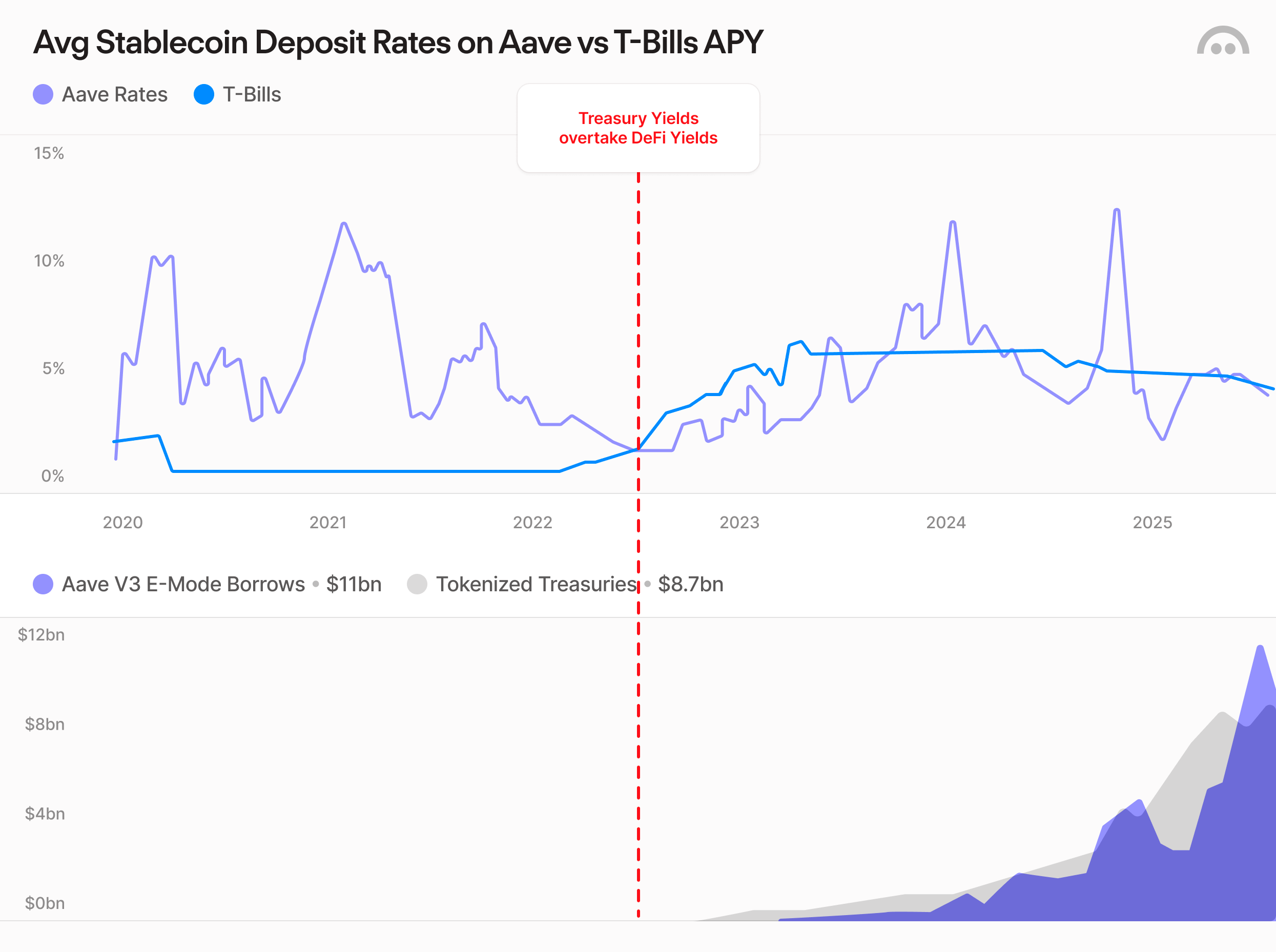
Image: Aave — Average stablecoin deposit rates on Aave versus T-Bill APY, 2020 through 2025, with the late-2022 crossover where Treasury yields overtook DeFi yields marked in red.
Quick solution
If you just want the short version: stablecoin yield comes from four main places — people borrowing your dollars on lending protocols, traders paying fees in liquidity pools, interest passed through from Treasury bills, and fixed-rate wrappers that smooth a variable rate for you. Lending deposits on a large audited protocol are the most transparent starting point, because the rate is set by real borrowing demand you can verify on-chain. Before you deposit anywhere, check three things: where the interest is generated, whether the platform has published audits and a track record through at least one crash, and how quickly you can withdraw. If any of the three is unclear, the extra yield is not worth it. For how lending deposits fit alongside borrowing, see our guide to how DeFi lending platforms handle risk.
Stablecoin yield does not exist in a vacuum. It competes with the safest dollar yield in the world: US Treasury bills. When the Federal Reserve moved rates to near zero in 2020, DeFi was one of the only places a dollar could earn anything, and capital flooded in. Aave Labs' analysis "Why DeFi Rates will Overtake TradFi," published 11 November 2025, traces this full cycle. DeFi total value locked grew from under 1 billion dollars at the start of 2020 to 15 billion by year-end, and Aave became the second protocol to pass 1 billion dollars in deposits.
The reverse happened in 2022. The Fed raised its target range by 525 basis points to 5.25 to 5.50 percent by mid-2023, the most aggressive tightening cycle in decades. Suddenly a Treasury bill paid more than a stablecoin deposit, risk-averse capital left DeFi, and total value locked fell nearly 80 percent over 2022. The chart above shows the exact crossover point where Treasury yields overtook DeFi yields.
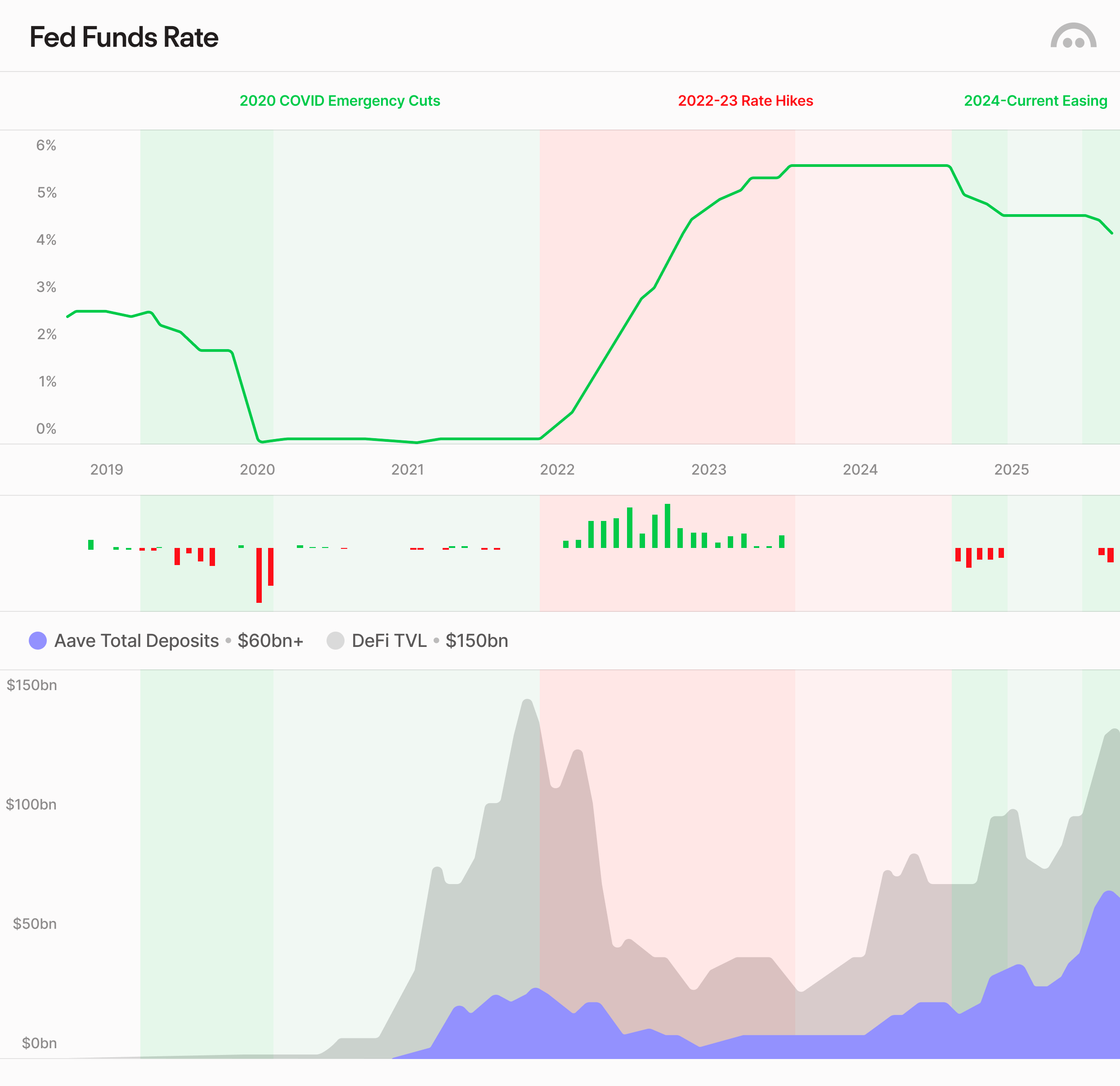
Since late 2024 the Fed has been easing again. In October 2025 it cut another 25 basis points to a 3.75 to 4.00 percent target range. Falling Treasury yields make stablecoin yield relatively more attractive, which is why on-chain rates spent much of 2024 and 2025 back above T-bills. The practical lesson for a saver: when the Fed is cutting, on-chain stablecoin rates tend to firm up; when the Fed is hiking, expect them to compress, and do not chase platforms that somehow defy that gravity, because unexplained yield is usually unpriced risk.
Source one: lending deposits, yield from real borrowers
The oldest and most transparent stablecoin yield source is a lending pool. You deposit USDC, USDT, or another stablecoin into a shared pool; borrowers post collateral such as ETH and pay interest to borrow your dollars; that interest, minus a protocol reserve cut, flows to depositors. The rate is set algorithmically by utilization — the share of the pool currently lent out — so it rises when borrowing demand is hot and falls when it cools. Nobody promises you a number; the market sets it.
This model matters because you can verify every part of it. On Aave, the largest lending protocol, you can see total deposits, total borrows, and the live rate for every asset on a public dashboard. During 2025, Aave's deposits grew from 35 billion dollars to 55 billion, peaking at 75 billion — a scale comparable to a top-50 US bank by deposits. The borrowing demand paying those yields is visible on-chain, block by block.
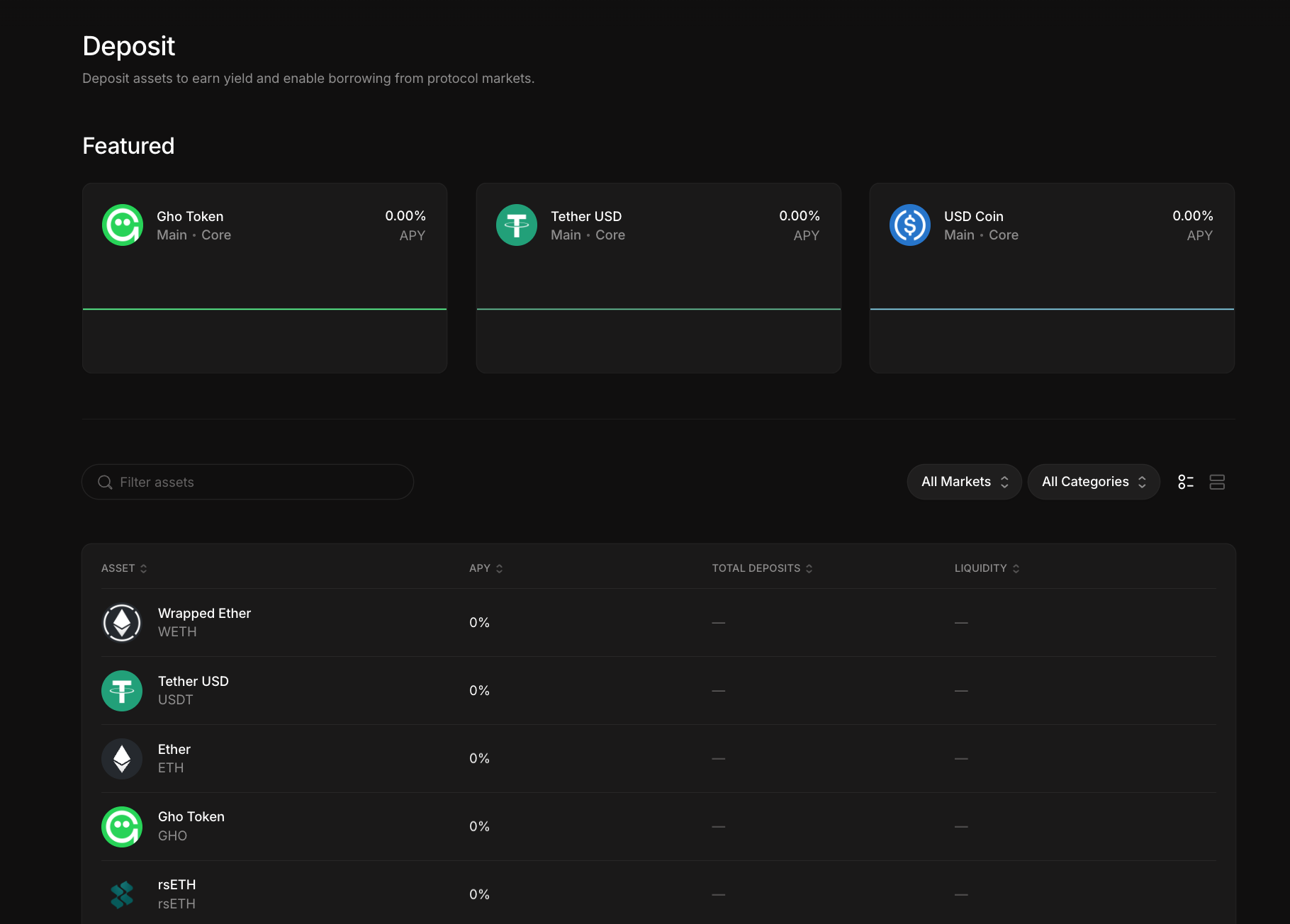
The trade-off is rate volatility. Lending yields track crypto market appetite for leverage. In quiet months a stablecoin lending rate can drift down to 2 or 3 percent; in a hot market it can spike into double digits for days. The Aave Pro User Guide, published 29 March 2026, explains how the protocol's V4 architecture organizes this: liquidity sits in Hubs, and Spokes connected to each Hub set the borrowing rules and risk parameters for specific markets, including dedicated spokes for stablecoin yield strategies. Different markets for the same stablecoin can pay different rates depending on the collateral rules of each spoke — stricter collateral usually means a lower but steadier rate.
If you want to understand the other side of the trade — the borrowers whose interest payments become your yield — our walkthrough of borrowing against crypto covers how those loans are collateralized and liquidated.
More in Staking & Yield
Source two: liquidity pools, yield from trading fees
The second source is providing liquidity on an automated market maker. In a stablecoin pool, you deposit two or more dollar-pegged tokens, and traders who swap between them pay a small fee on every trade. Your yield is your share of those fees, sometimes plus token incentives from the protocol.
Stable-to-stable pools avoid most of the impermanent loss that plagues volatile pairs, because both assets aim at the same one-dollar price. But they concentrate a different risk: if one stablecoin in the pool loses its peg, the pool automatically fills up with the failing asset as arbitrageurs dump it there. Liquidity providers end up holding the worst asset in the basket precisely when it is failing. That is not a theoretical risk — depeg events have burned pool depositors in every market cycle. Fee yield on stable pools is usually modest, in the low single digits, and the incentive portion can vanish when a protocol changes its emissions.
Treat liquidity-pool yield as a distinct product, not a savings account: it pays you for taking basket risk on every asset in the pool, and it deserves the same due diligence you would apply to evaluating a DeFi protocol's safety.
Variable rates are honest but uncomfortable. A saver planning around 5 percent does not enjoy watching it drop to 2.8 percent mid-quarter. The newest category of stablecoin yield products smooths this out: a vault accepts deposits, deploys them into variable-rate strategies, and pays users a stable advertised rate, keeping the spread — or eating the shortfall — as the operator's business.
Aave Labs formalized this pattern with Stable Vaults, announced 9 July 2026. The system converts variable on-chain lending rates into a fixed rate an operator commits to, handles rebalancing across chains and strategies, and works with any ERC-4626 vault strategy. It already powers the savings feature in the Aave mobile app, where users earn through Savings GHO, and is now open for any fintech, wallet, or neobank to embed.
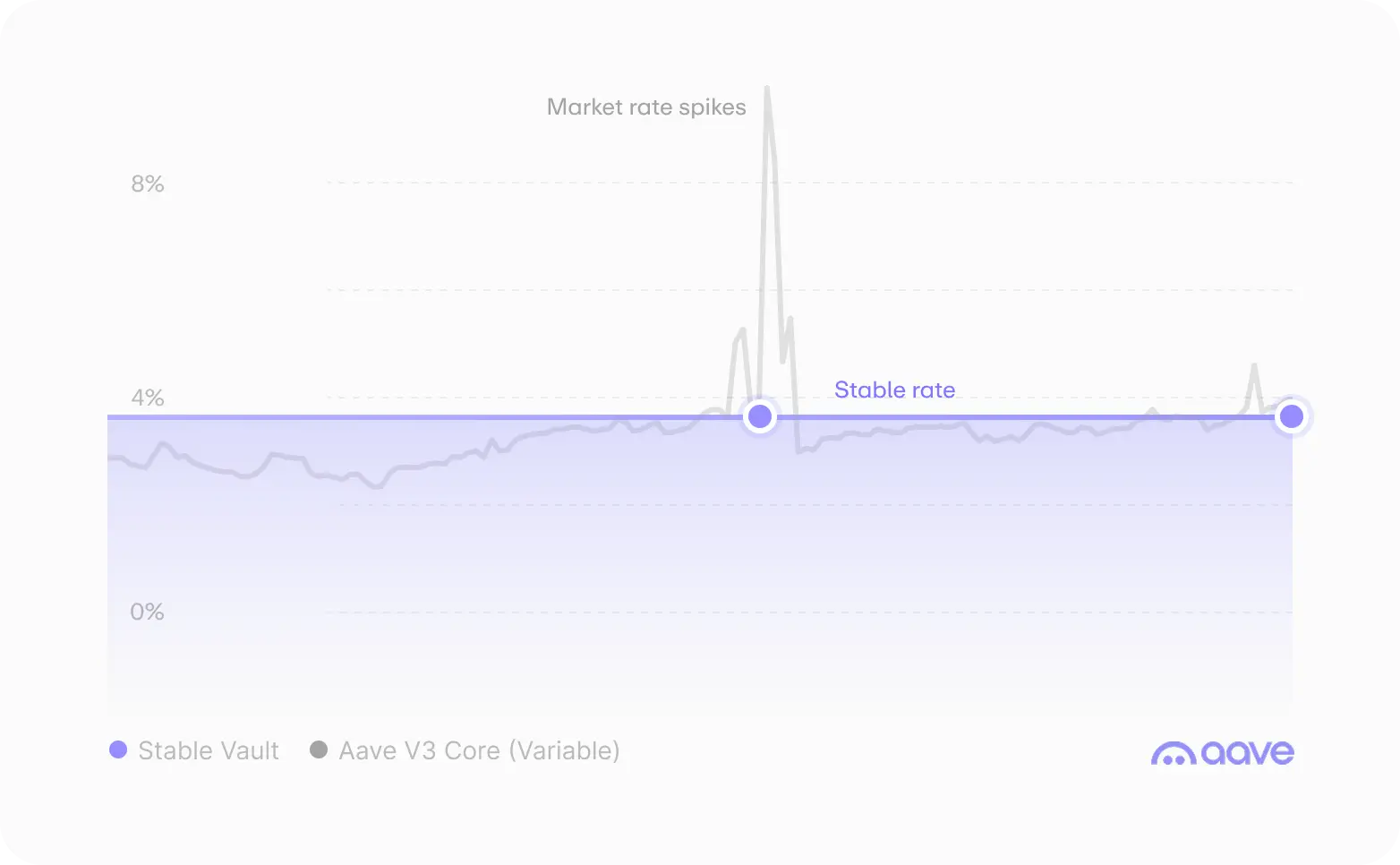
For a saver, fixed-rate products remove rate anxiety but add a counterparty question: the operator sets the rate and manages the strategy, so you are trusting their solvency management, not just the underlying protocol. Read who the operator is, what strategies back the rate, and what happens if the underlying yield falls below the promise. A committed rate meaningfully above the going variable rate should make you more suspicious, not less.
Source four: Treasury-backed yield brought on-chain
The 2022 rate shock created a fourth category: tokenized Treasury products. When T-bills paid more than DeFi, builders tokenized them, bringing 5 percent government yield on-chain and attracting names like BlackRock and Franklin Templeton into tokenized money market funds. By late 2025, tokenized Treasuries had grown to roughly 8.7 billion dollars, against about 11 billion in comparable Aave stablecoin leverage markets.
Treasury-backed yield behaves differently from crypto-native yield. It tracks the Fed directly: when rates fall, so does the yield, with no crypto bull market to offset it. It also usually involves permissioned access, know-your-customer checks, or geographic restrictions, since a regulated security sits underneath. For a US-based saver who can simply buy T-bills in a brokerage account, tokenized versions add little; their real value shows up where dollar accounts are hard to open.
The people using stablecoin yield are not mostly traders. Aave Labs' research report "How Aave is Powering Latin America's Stablecoin Revolution," published 8 December 2025, shows the clearest picture. Crypto transfer volumes in Latin America accelerated from 53 percent to 63 percent year-over-year growth in 2025, driven by savers protecting themselves from local currency devaluation.
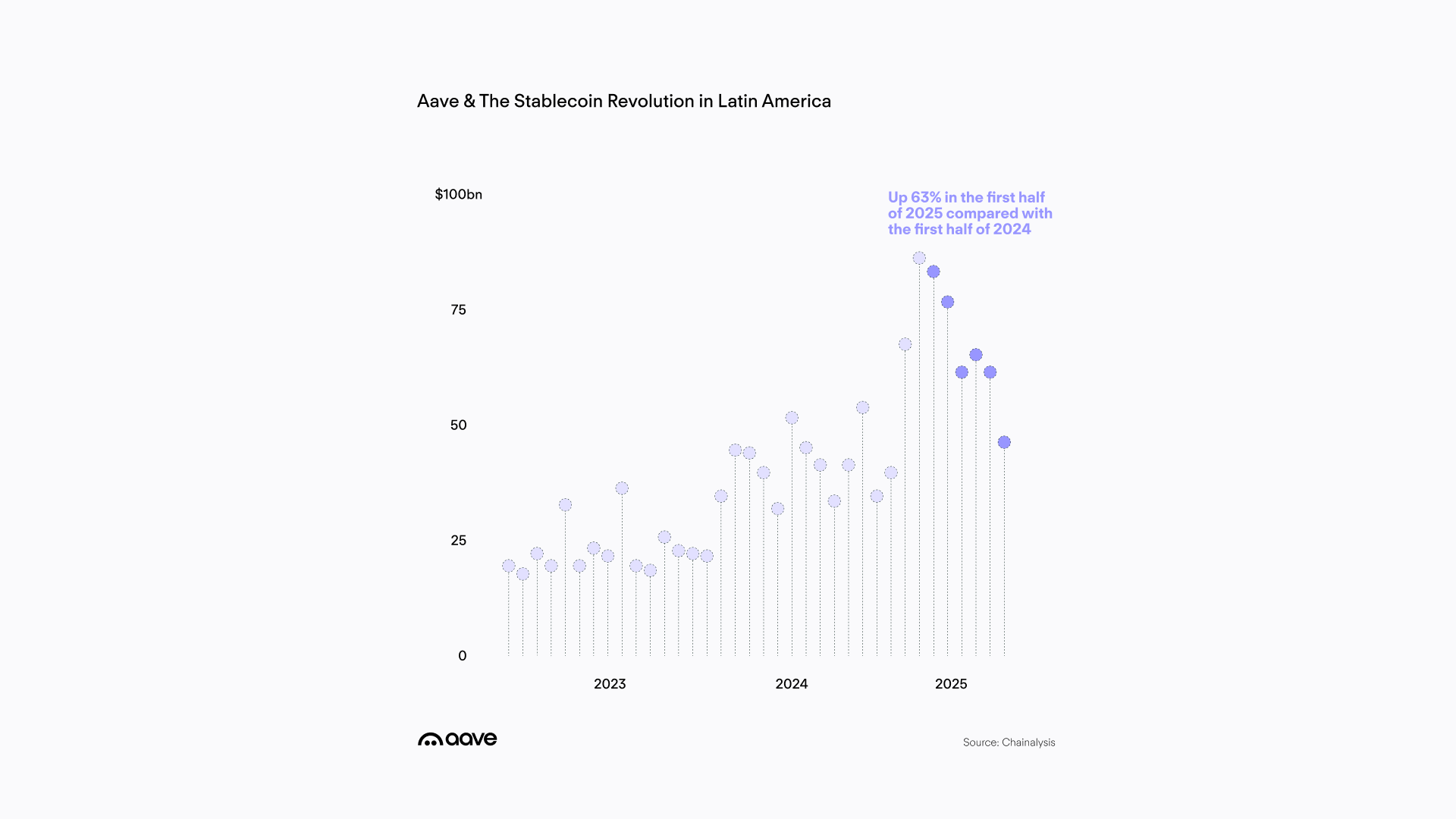
The report's case study is Argentine fintech Lemon, which integrated Aave in 2022 to power its Earn program. More than 130,000 Lemon users — up 73 percent year-over-year — earn yield on roughly 40 million dollars of deposits, over 20 million of it in stablecoins, without ever touching a DeFi interface themselves. The stablecoin hedges the currency; the yield grows the balance. That two-layer benefit is the whole point of stablecoin yield done right.
Comparing your stablecoin yield options
Because no single public source compares the main stablecoin yield categories on source, rate behavior, and failure modes, we compiled one from Aave Labs' November 2025 rate-cycle analysis, its July 2026 Stable Vaults announcement, and its March 2026 V4 documentation.
| Yield option | Where the interest comes from | Rate behavior | Main thing that can go wrong | Best fit |
|---|---|---|---|---|
| Lending deposits (Aave and similar) | Borrowers paying interest on overcollateralized loans | Variable, tracks borrowing demand; 2 to 10 percent plus in cycles | Rate drops in quiet markets; smart contract or oracle failure | Savers who want transparent, verifiable yield |
| Stablecoin liquidity pools | Swap fees from traders, plus incentives | Low single digits; incentives can vanish | A depeg fills the pool with the failing coin | Experienced users who understand basket risk |
| Fixed-rate vaults (Stable Vaults, sGHO) | Variable lending yield smoothed by an operator | Fixed committed rate | Operator mismanages the spread or the promise | Savers who value predictability over peak rate |
| Tokenized Treasuries | US government T-bill interest passed through | Tracks the Fed funds rate directly | Falls with every Fed cut; access restrictions | Users outside easy reach of US brokerages |
| Exchange "earn" accounts | Often undisclosed lending or trading | Whatever the platform advertises | Opaque custody; withdrawals frozen in a crisis | Nobody, until the platform discloses its source |
The last row is deliberate. Any product that advertises a stablecoin rate without telling you where the interest is generated belongs in a different risk category from everything above it, no matter how established the brand looks.
First, identify the yield source. If the documentation cannot complete the sentence "depositors are paid because…" with a mechanism you can verify, walk away.
Second, check the rate against context. Compare the offer with the current T-bill rate and the live rate on a major lending protocol. An offer far above both needs an extraordinary explanation.
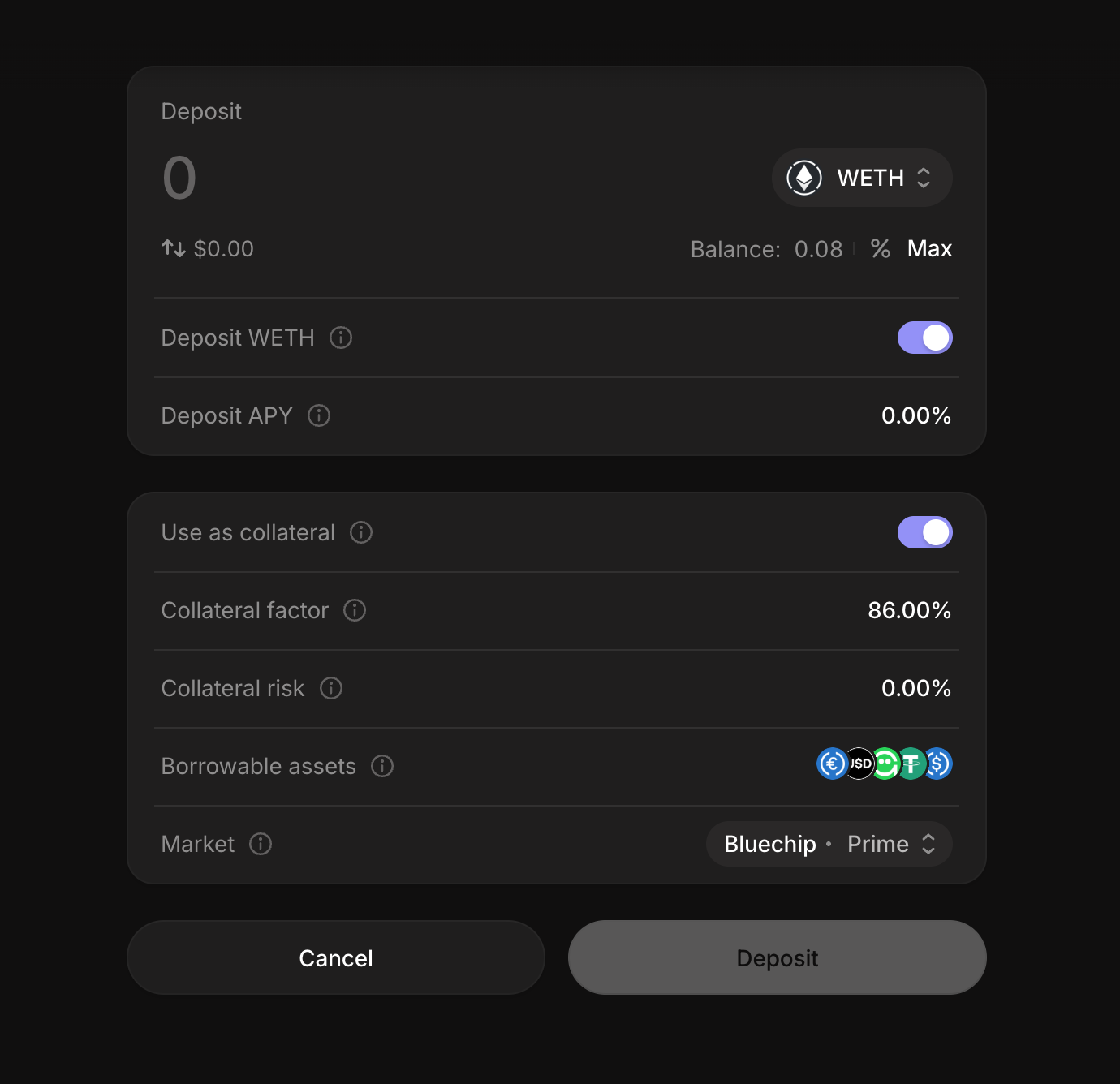
Third, read the risk controls. On a lending protocol, look at collateral factors, liquidation history, and audits. The deposit flow itself will show you the parameters — collateral factor, borrowable assets, market risk tier — before you commit funds.
Fourth, test the exit. Small deposit, then a withdrawal, before you move meaningful money. Note how long it takes and what it costs.
Fifth, size the position. Stablecoin yield is a cash-management tool, not a lottery ticket. Even the best-run pool carries smart contract risk that a bank account does not, so it should hold a slice of your dollar savings, not all of them.
Which option fits your situation
"We are a household in a high-inflation country holding dollars in a fintech app." You are the LatAm profile from the Chainalysis data above, and you likely already earn through an embedded product like Lemon's Aave-powered Earn. Confirm which protocol sits underneath your app's yield feature and whether it discloses the rate source. If it does, the app's convenience is worth a slightly lower rate than going direct.
"We are a small business keeping a stablecoin operating float between invoices." Predictability beats peak yield for you. A fixed-rate product such as a Stable Vault, or a conservative lending deposit on a blue-chip protocol, lets you plan cash flow without watching rate charts. Keep the float split from long-term reserves and test withdrawal timing before payroll depends on it.
"We are a crypto-native saver comfortable with wallets and willing to monitor positions." Go direct to a major lending protocol for the base rate, and consider layering a spoke-specific stablecoin strategy only after reading its collateral rules. You have the skills to verify utilization and rate history on-chain, so use them — your edge is verification, not risk appetite.
- Chasing the highest advertised number. The extra 3 percent on an unknown platform is not free; it is the market pricing a risk you have not identified yet. Every major yield blowup started as a table-topping rate.
- Ignoring the rate cycle. Depositing at the peak of a borrowing frenzy and expecting 10 percent forever leads to disappointment and platform-hopping. Rates mean-revert with the Fed cycle and market leverage.
- Treating a liquidity pool like a savings account. Pool deposits carry basket risk on every asset in the pool. If you would not hold each stablecoin in the pool on its own, do not hold the pool.
- Leaving yield on an exchange earn product with no disclosed source. Custodial earn programs have frozen withdrawals in every major crisis. On-chain alternatives let you verify reserves and exit on your own schedule.
Frequently asked questions
Is stablecoin yield safe?
No yield is risk-free, including this one. The risks are different from a bank account: smart contract bugs, stablecoin depegs, and rate volatility replace bank failure risk. A large audited lending protocol with a multi-year track record is the conservative end of the spectrum; anonymous high-rate farms are the reckless end. Deposit insurance does not exist on-chain.
Why do stablecoin rates change so much?
Because most on-chain yield is set by supply and demand for borrowing, not by a committee. When traders want leverage, they pay more to borrow stablecoins and depositor yields rise. When markets cool, or when Treasury yields outcompete DeFi, demand falls and rates compress. The Fed's cycle since 2020 — near zero, then 5.5 percent, now easing — is visible in every on-chain rate chart.
What is a realistic stablecoin yield right now?
Anchor your expectations to two numbers: the current T-bill yield and the live stablecoin deposit rate on a major lending protocol. Through 2024 and 2025 those ranged roughly from 3 to 8 percent depending on market heat. Anything dramatically above the lending-protocol rate requires a specific, verifiable explanation — token incentives, a promotional subsidy, or risk you are being paid to hold.
Are fixed-rate stablecoin products better than variable ones?
They solve different problems. Variable lending rates pay you exactly what the market clears, with full transparency. Fixed-rate vaults such as Aave's Stable Vaults trade a little upside for predictability, which suits planning-minded savers and any business embedding yield in an app. The fixed rate is only as good as the operator's management of the underlying variable strategies, so the operator's identity and controls matter.
Do I owe taxes on stablecoin yield?
In most jurisdictions, yes — stablecoin interest is generally taxable income as it accrues or is received, just like bank interest, and some jurisdictions also treat each token movement as a disposal event. Rules differ widely by country and product structure, so keep records of every deposit, withdrawal, and reward, and confirm treatment with a local tax professional before you rely on any specific interpretation.
Sources
- Aave Labs, "Why DeFi Rates will Overtake TradFi" — rate cycle history, TVL data, and the T-bill crossover (published 11 November 2025).
- Aave Labs, "Introducing Stable Vaults" — fixed-rate vault architecture and Savings GHO integration (published 9 July 2026).
- Aave Labs, "How Aave is Powering Latin America's Stablecoin Revolution" — Chainalysis-sourced LatAm adoption data and the Lemon case study (published 8 December 2025).